The Future of Dating Apps and AI in 2026: What's Actually Changing
# The Future of Dating Apps and AI in 2026: What's Actually Changing **By Ada Jin, Co-Founder of LAMU** *Published June 6, 2026 · 8 min read · Last updated Jun...
By Ada Jin
LAMU Editorial
TL;DR
The future of dating apps in 2026 is AI — but not in the way most people expect. The big platforms (Tinder, Bumble, Hinge) are bolting AI onto a broken model to slow declining subscribers. The more significant shift is happening at the edges: a new generation of agentic AI matchmaking platforms that have abandoned the swipe entirely and rebuilt the model around curated introductions, values-based compatibility, and in-person connection. By 2030, 85% of new relationships are projected to involve AI in the matching process. The question isn't whether AI will shape your dating life. It's whether the AI working on your behalf is optimized for engagement — or for outcomes.
The Swipe Era Is Ending. Here Is the Data.
I want to start with the numbers, because they tell a story the industry doesn't want to tell clearly.
Tinder posted its first-ever annual revenue decline in 2025 — down 4% year-over-year — after paying subscribers fell from a peak of 10.8 million to 9.8 million (Match Group Q4 2025 Earnings). Bumble's paying users fell 21% year-over-year in Q1 2026 to 3.2 million, with total revenue down 14.1% (Bumble Q1 2026 Earnings). The company's stock collapsed from a post-IPO high near $76 to under $5 by early 2025. Even Hinge — the bright spot in the Match Group portfolio, with 26% revenue growth — operates in a category where 69% of downloaded dating apps are deleted within a month (AppsFlyer, 2025), up from 65% the year before.
Over 380 million people worldwide use dating apps. Over 78% of them report burnout (Forbes Health, 2025). The apps have never had more users. They have also never had less trust.
This is the context in which every major platform is now racing to integrate AI. Not because AI makes the swipe model work better — but because the swipe model is failing, and AI is the most credible story available about what comes next.
What "AI in Dating Apps" Actually Means in 2026
When Tinder, Bumble, and Hinge say "AI," they generally mean one of three things:
1. AI for profile optimization. Suggesting better photos, writing prompts on your behalf, coaching you on your bio. Bumble launched AI-generated profile prompts in 2025. Hinge is testing conversation starters. These are AI features that make the app stickier — they keep you investing more in a profile on their platform.
2. AI for safety and moderation. Bumble's "Deception Detector" reduced spam and fake account reports by 45% within two months of launch. Match Group is investing in AI-powered photo verification. These are genuinely good applications of AI — but they solve a platform hygiene problem, not the core problem of finding a compatible person.
3. AI for matching. Adjusting algorithms based on behavioral signals, message quality, and engagement patterns rather than just swipe volume. Hinge's "We Met" feedback loop uses real date outcomes to improve future match quality. This is the most meaningful category — and it's also where the gap between incumbent apps and purpose-built AI matchmaking platforms is widest.
Here is what none of the big apps will say publicly: their AI is still optimized for retention, not relationships. The moment their algorithm genuinely gets good at finding you a lasting relationship, it succeeds itself out of a customer.
The Real Future: From Discovery Platforms to Agentic Matchmaking
The more consequential shift isn't happening inside Tinder. It's happening in a new category that barely existed two years ago: agentic AI matchmaking.
Agentic AI doesn't just surface profiles for you to evaluate. It acts on your behalf — gathering information about your values and personality, identifying compatible people from its network, and making introductions without requiring you to scroll endlessly through a catalog of faces. You describe who you are and what you're looking for. The AI does the rest.
This is closer to what a great human matchmaker does than what any dating app has ever done. And it's arriving at a moment when people are not just bored of apps — they're actively searching for a different model. U.S. searches for "matchmaker" nearly doubled from January 2025 to January 2026, according to Ahrefs data reported by Global Dating Insights.
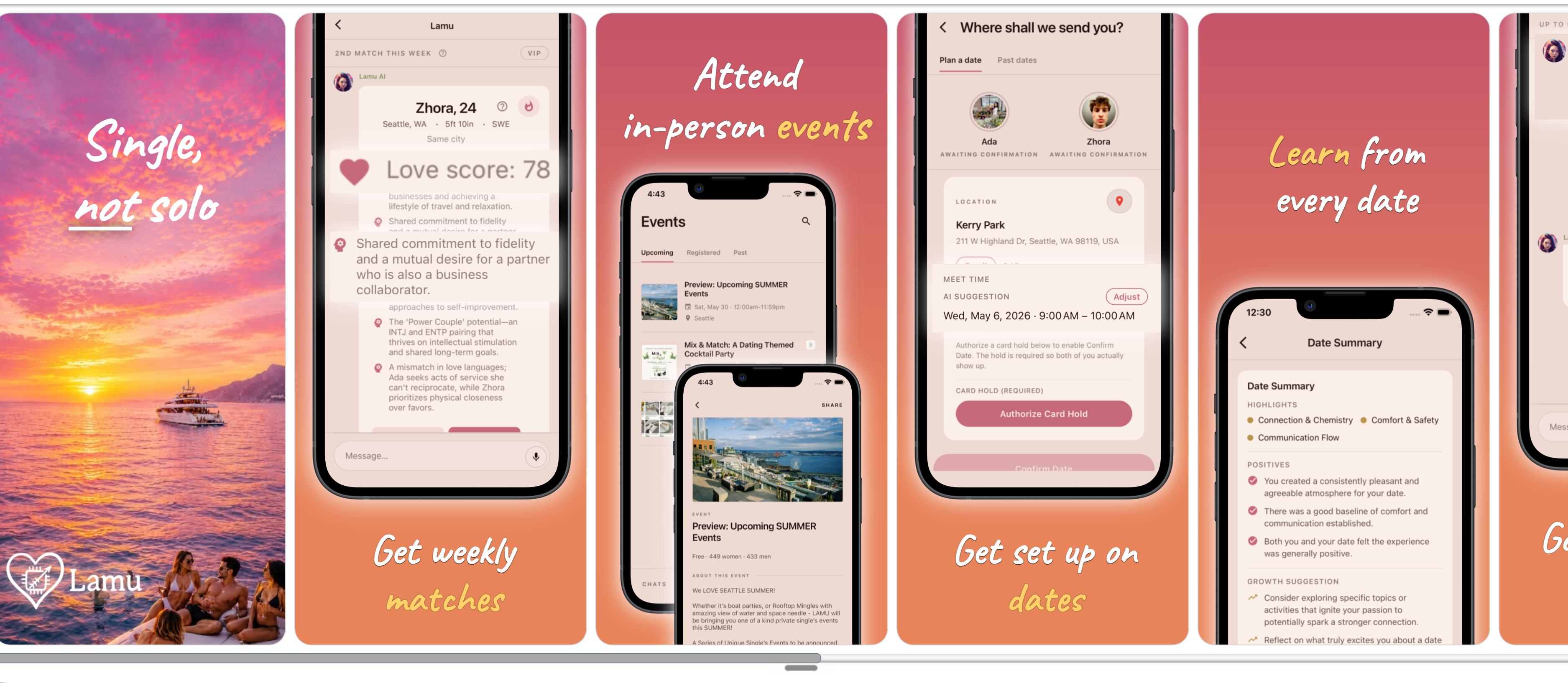
Several startups are building in this direction: Fate (London-based, voice-AI driven, no swiping), Ditto (one AI-selected match per week), Three Day Rule (guaranteed matches at $25/month), and LAMU — our platform, here in Seattle — which combines continuous AI learning with curated in-person events for professionals aged 25–35.
The through-line is the same everywhere: get rid of the catalog, build in the introduction, optimize for the relationship.
Why the Swipe Model Conflicts With Relationships — Structurally
This is the part I want to spend a moment on, because it's the thing I understood before I built LAMU, and it's the thing that most people don't realize until they've wasted two years on apps.
Dating apps are architecturally designed to produce a specific psychological loop: hope, action, reward, disappointment, repeat. Neuroscientific research confirms that repetitive swiping activates the same dopaminergic reward pathways as slot machines — intermittent reinforcement, rapid binary feedback, and the constant suggestion that the next profile might be the one. (ScienceDirect, 2025)
This loop is not a bug. It is the product. An app that quickly matched you with a compatible person and then saw you leave would be a terrible business. An app that kept you engaged for months, spending $30/month on premium features, while you slowly filtered through a pool of millions — that's a good business.
AI overlaid on that architecture doesn't change the architecture. It makes the loop more sophisticated. It personalizes the slot machine. It doesn't change what the slot machine is for.
Agentic AI matchmaking is built on a different architecture entirely. The business model succeeds when you find a relationship. That means the AI is genuinely incentivized to understand you accurately, identify the right person, and facilitate a connection that lasts. The incentive alignment is completely different — and incentive alignment determines product design more than any feature roadmap does.
What Changes for Users: A Before and After
| Dimension | Dating Apps Today | AI Matchmaking (LAMU Model) |
|---|---|---|
| Your role | Browse, evaluate, screen | Describe yourself; receive introductions |
| Time investment | 51+ min/day swiping (Forbes Health, 2024) | Minimal — system works for you |
| First contact | Cold message to a stranger | Warm mutual introduction |
| What AI analyzes | Engagement patterns, swipe behavior | Values, personality, life goals, communication style |
| Optimization target | Time on app (retention) | Relationship outcome |
| Business model incentive | You stay single and engaged | You find a relationship and leave |
| Cost | Free–$30/month (premium), ongoing | Low monthly / fraction of human matchmaker |
| In-person element | None (app-only) | Curated events built into the model |
The In-Person Piece That AI Can't Replace — and Shouldn't Try To
Here is something important that I think a lot of the AI dating discourse gets wrong: AI should facilitate human connection, not substitute for it.
Hinge CEO Justin McLeod said it clearly on the New York Times Hard Fork podcast: "The journey of dating is something that I think we each need to take on our own." I agree. An AI agent that dates on your behalf — negotiating your compatibility, writing your messages, deciding who you meet — isn't solving the loneliness problem. It's deepening it.
The right role for AI in dating is what a great matchmaker has always done: listen carefully, understand deeply, and make a thoughtful introduction. Then step back and let two human beings figure out if there's something real there.
That's why LAMU combines AI matchmaking with a calendar of curated in-person events. This summer in Seattle, we're organizing boat parties on Lake Washington, wakeboarding sessions, and guided day trips through the Ballard Locks — group experiences for pre-screened members where connection can develop naturally, without anyone staring at a phone. The AI does the pre-selection. The events create the shared experience that research consistently shows produces the most lasting connections.
Research by Stinson et al. (Social Psychological and Personality Science, 2021) found that nearly 70% of long-term romantic relationships begin as friendships or through in-person social connection — not cold digital introductions. AI can dramatically improve the quality of the introduction. Only you can turn that introduction into something real.
Where the Industry Goes From Here: Three Predictions
1. The big apps converge on "slow dating."
Both Tinder and Hinge are experimenting with limiting daily swipes, surfacing fewer but higher-quality profiles, and using AI to de-emphasize volume. The "slow dating" movement — more intentional, less scroll — is gaining traction especially among Gen Z. The apps are following their users here, not leading them.
2. Agentic matchmaking goes mainstream.
The startups building swipe-free, introduction-based AI matchmaking are still small. But they're solving the right problem, and the evidence that the incumbent model is failing continues to accumulate. By 2028–2030, this category will likely be the dominant model for relationship-seeking singles under 40 — the same way streaming replaced the video rental store: not all at once, then suddenly.
3. In-person becomes a competitive differentiator.
As AI gets better at the digital layer of matching, the differentiator shifts to what happens off-screen. Platforms that can translate good AI matching into good in-person experiences will win the long game. That's true for LAMU in Seattle today, and it will be true for the category broadly.
What This Means If You're Single Right Now
If you're using Hinge or Bumble and it's working — keep going. These apps have real users and real marriages in their track record.
But if you find yourself spending an hour a day swiping, burning out on conversations that fizzle after three messages, or feeling like the system is designed to keep you searching rather than help you find — that instinct is correct. You're not failing the system. The system is failing you. And a category of platforms is now being built specifically to fix that.
The future of dating apps is not more features on a broken model. It's a different model entirely.
"Every major platform is now asking: how do we add AI to what we already built? The better question is: if we were building this from scratch today, knowing what AI can do, would we build it this way at all? We wouldn't. Nobody would build a slot machine and call it a matchmaker. That's what LAMU is — the answer to that question."
— Ada Jin, Co-Founder, LAMU
By the Numbers
| Stat | Source |
|---|---|
| 380M+ people worldwide use dating apps | Statista, 2026 |
| 78% of dating app users report burnout | Forbes Health, 2025 |
| 69% of dating apps deleted within one month of download | AppsFlyer, 2025 |
| Tinder first-ever annual revenue decline: –4% in 2025 | Match Group Q4 2025 Earnings |
| Bumble paying users down 21% YoY in Q1 2026 | Bumble Q1 2026 Earnings |
| Hinge revenue grew 26% YoY — fastest-growing major app | Match Group Q4 2025 Earnings |
| 85% of new relationships projected to involve AI by 2030 | AllAboutAI, 2026 |
| AI usage in dating increased 333% in one year | Match/Kinsey Institute study, 2025 |
| U.S. searches for "matchmaker" up ~108% Jan 2025 → Jan 2026 | Ahrefs via Global Dating Insights, 2026 |
| Nearly 70% of long-term relationships begin through in-person connection | Stinson et al., 2021 |
| LAMU AI matchmaking: ~0.5% of the cost of a human matchmaker | LAMU, 2026 |
Ada Jin is the co-founder of LAMU, an AI matchmaking platform and singles club on a mission to end swipe culture and build the future of intentional dating. Previously at Meta, TikTok, and Marshall Wace. Based in Seattle.
Download LAMU on iOS · Download on Android · See upcoming LAMU events in Seattle
FAQ
Frequently Asked Questions
What is the future of dating apps and AI in 2026?
The future of dating apps in 2026 is a split between two models. Incumbent apps like Tinder, Bumble, and Hinge are integrating AI as a retention tool — improving profiles, conversation coaching, and safety moderation — without changing their core swipe-and-scroll architecture. The more significant trend is the rise of agentic AI matchmaking platforms that have abandoned swiping entirely and replaced it with values-based analysis, curated introductions, and in-person connection. By 2030, 85% of new relationships are projected to involve AI in the matching process. The winning platforms will be those whose AI is optimized for relationship outcomes rather than time spent on the app.
Will AI replace dating apps?
AI will not replace dating apps — it will replace the swipe model inside them. The big platforms are already rebuilding their matching logic around AI. The structural question is whether that AI serves the user's goal (a relationship) or the platform's goal (continued engagement). Agentic AI matchmaking startups — platforms like LAMU, Fate, and Ditto — are betting that the right answer is a completely different product architecture, not just better algorithms layered onto the existing one. The swipe-and-catalog model is declining. What replaces it will be AI-powered, but the design philosophy behind that AI is what determines whether it actually helps people find love.
How is LAMU different from AI features on Hinge or Bumble?
Hinge and Bumble use AI to optimize their existing swipe-based platforms — better profile prompts, conversation starters, safety tools, and algorithmic ranking. You still browse a catalog of people and initiate cold contact. LAMU is built on a different model entirely: our AI analyzes your values, communication style, and long-term compatibility, then makes a warm mutual introduction — no catalog, no cold messaging, no swiping. LAMU also combines AI matching with curated in-person events, so members meet in shared-experience contexts that research shows are more likely to produce lasting relationships. LAMU's AI matchmaking costs approximately 0.5% of what a traditional human matchmaker charges, while targeting the same outcome: a relationship, not just a date.
Is AI matchmaking better than traditional dating apps for finding a serious relationship?
For serious relationship seekers, yes — the incentive structures are fundamentally different. A dating app profits when you stay single and engaged. An AI matchmaking platform succeeds only when you find a relationship. That difference in business model produces a different product. Professional matchmaking services report long-term relationship success rates of 60–80%, compared to under 12% for unguided dating app use (Pew Research Center). AI matchmaking delivers a similar curated, outcome-focused model at a fraction of the cost. Only 12% of dating app users find a serious relationship through apps; the majority of long-term relationships form through warm introductions and in-person connection.
What AI dating apps are leading in 2026?
Among incumbent platforms, Hinge is the fastest-growing major app by revenue (up 26% YoY) and leads on serious-relationship intent, with 90% of users reporting they want a committed relationship. Among newer agentic AI matchmaking platforms, LAMU (Seattle, professionals 25–35), Fate (London, voice-AI driven), Ditto (one weekly AI-selected match), and Three Day Rule ($25/month, guaranteed introductions) represent the leading edge of a category that has abandoned the swipe in favor of curated introductions and values-based AI analysis. The agentic matchmaking category is still small but growing rapidly as swipe fatigue accelerates and incumbent app subscriber numbers continue to decline.
The LAMU Blog
More reflections on modern intimacy and intentional connection.