Tired of Swiping? Here's Exactly What to Do Instead
# Tired of Swiping? Here's Exactly What to Do Instead **By Georgiy Lapin, Co-Founder of LAMU** *Published June 6, 2026 · 7 min read · Last updated June 6, 2026...
By Ada Jin
LAMU Editorial
TL;DR
If you're tired of swiping, the most effective alternatives are: joining an AI matchmaking platform that makes introductions for you, attending curated singles events where shared experience creates natural connection, activating your social network for warm introductions, and building an intentional real-world social life through activity-based communities. Swiping fatigue isn't a personal failure — it's the rational response to an app model designed to keep you searching, not finding. Nearly 4 in 5 dating app users report burnout (Forbes Health, 2025). The good news: there are better ways, and they have better outcomes.
Let Me Be Honest About Why You Feel This Way
I co-founded LAMU. So you might expect me to open with "delete the apps, download LAMU." But that's not where I want to start.
I want to start with something I find genuinely troubling about the conversation around dating app burnout — which is how quickly it turns into self-blame.
You're not bad at dating. You're not too picky. You're not too something or not enough something else. You are experiencing a designed outcome.
Dating apps are built on variable ratio reinforcement — the same psychological mechanism that makes slot machines hard to put down. Every swipe carries the possibility of a match. Every match carries the possibility of chemistry. The reward is unpredictable, which makes the behavior compulsive. Neuroscientific research confirms that repetitive swiping activates dopaminergic reward pathways in the brain — the same circuits involved in gambling. (ScienceDirect, 2025)
A review of 45 studies found that over 85% showed a connection between dating app use and poor body image, while nearly 50% found links to lower self-esteem, higher anxiety, and depression. (Bowman et al., 2025) Swipe-based dating app users showed significantly higher rates of psychological distress (OR = 2.51) and depression (OR = 1.91) compared to non-users in a peer-reviewed cross-sectional study. (NCBI, 2020)
The apps didn't fail you. They worked exactly as designed. The problem is that what they're designed for — keeping you engaged — is the opposite of what you're looking for — a relationship.
Once you see that clearly, the path forward gets a lot simpler.
What to Do Instead: Six Alternatives That Actually Work
1. Use an AI Matchmaking Platform — Not an App
The most direct replacement for swiping is a platform that does the finding for you.
The core problem with dating apps isn't the technology — it's the architecture. Apps give you a catalog to scroll. You do the searching, the screening, and the cold outreach. The whole emotional burden of finding someone is placed on you, inside a system whose business model depends on you not succeeding.
AI matchmaking platforms flip that entirely. Instead of handing you an infinite scroll, they analyze your values, personality, and what you're genuinely looking for — then make a warm, mutual introduction to someone with high predicted compatibility. No cold messages. No swiping. No "seen and ignored." The system works for you rather than extracting attention from you.
This is what professional human matchmakers have always done. The difference is cost. A human matchmaker charges $5,000 to $50,000. LAMU's AI matchmaking delivers the same curated introduction model at approximately 0.5% of that cost — accessible to anyone who is serious about finding a relationship without the full-time job of searching for one.
The key distinction: an AI matchmaking platform succeeds when you find a relationship. A dating app succeeds when you stay on it. That single difference in incentive structure produces a completely different product.
2. Join a Singles Club That Does Things Together
There is a version of meeting people that most adults quietly believe in but rarely act on: meeting someone while you're both doing something you love, and discovering each other in that context rather than through a profile.
Research by Stinson et al. (Social Psychological and Personality Science, 2021) found that nearly 70% of long-term romantic relationships begin as friendships or through in-person social connection. People consistently rated "a friendship turning romantic" as the best way to start a relationship — far ahead of dating apps and blind dates.
The problem is that most adults don't have a natural infrastructure for this anymore. You've aged out of school. Your friend group is stable. Work has its own complications. The spontaneous overlap that made meeting people easy in your 20s doesn't exist in the same way.
A singles club designed around shared activities recreates that infrastructure deliberately. This is exactly what LAMU is building in Seattle — not just a matchmaking app, but a community of like-minded professionals who actually do things together.
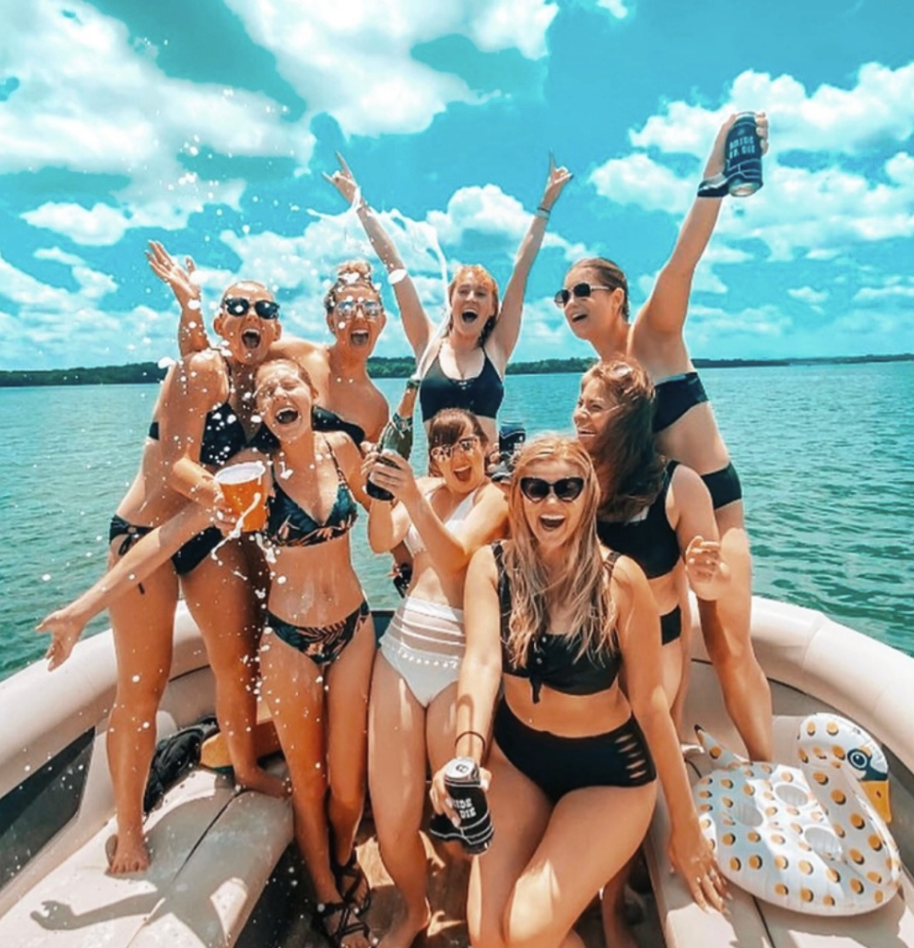
This summer, we're organizing a full calendar of water activities on Lake Washington and Lake Union:
- ◆🚤 Boat parties — pre-screened members, sunset views, small enough groups that you'll actually have real conversations
- ◆🏄 Wakeboarding sessions on Lake Washington — beginner-friendly, genuinely fun, a shared challenge that creates instant bonding
- ◆⛵ Boating day trips through the Ballard Locks and Puget Sound
A private charter on Lake Washington runs $150–$900+ per hour if you book independently. LAMU organizes these at group rates for members — the same beautiful experience, shared with people who were pre-selected because they share your values and relationship intent, at a price that makes it actually accessible.
When you meet someone on a boat at golden hour on Lake Washington, you have a story. You have context. You saw how they treated the captain, whether they jumped in the water, whether they laughed easily. That is a fundamentally richer starting point than a photo and a three-word bio.
Active first dates are 25% more likely to lead to a second date than passive ones. (Tawkify, 2025) Shared experiences work. Build them into your dating life deliberately.
3. Actually Ask Your Friends
This sounds almost too simple. It isn't.
Most single adults who want to be set up have never directly, specifically asked the people closest to them to make an introduction. They've maybe hinted at it. They've complained about apps. They haven't said: "I'm genuinely looking for a relationship. If you know someone you think I'd connect with, I'd really appreciate an introduction."
Couples who meet through mutual friends are 30% more likely to stay together long-term than those who meet online. (Pew Research, 2025) The reason is intuitive: there is built-in trust, social accountability on both sides, shared context, and a mutual connection who can vouch for both people's character.
About 15% of couples in 2025 met through a friend — making it the second most common meeting method after apps, but with substantially better long-term outcomes.
Your friends know you. They know who you are in real life, not in a profile. Give them the chance to use that knowledge.
4. Build a Social Life Designed for Organic Connection
The biggest strategic mistake single adults make is treating dating as a separate activity from their life — an app they open at night rather than a natural feature of a life lived in contact with people.
The "third space" concept — spaces that are neither home nor work, where people gather regularly around a shared interest — is where most lasting relationships have always formed. Running clubs. Rock climbing gyms. Book clubs. Volunteer organizations. Pottery classes. The communities that bring the same people together repeatedly, in a context where chemistry can develop naturally over time.
79% of Gen Z singles are forgoing regular dating app usage in favor of in-person interactions (Axios / Generation Lab, 2023) — not because in-person is trendy, but because it works. When the purpose of a gathering is to do something rather than evaluate each other, attraction develops more authentically. There is no performance pressure. You just show up as yourself.
This is a longer game than downloading an app. It requires investing in your social life as a genuine priority, not just a backdrop. But the connections it produces are qualitatively different — and the research consistently shows they last longer.
5. Try Compatibility-First Apps on Your Own Terms
If you're not ready to leave apps entirely — or you want to use them alongside other approaches — use them intentionally rather than compulsively.
Not all apps are built the same. Hinge (prompt-based profiles, limited daily likes, "We Met" feedback loop) produces meaningfully different outcomes than Tinder's infinite scroll. eHarmony's 32-dimension compatibility quiz self-selects for serious users — people who finish a 30-minute quiz are not casually browsing.
The single most effective change you can make to how you use any app: set a 15-minute daily limit and honor it. Apps are designed to expand to fill whatever time you give them. Constraining that time forces you to be more intentional — to engage seriously with one person rather than scroll past twenty.
6. Be Explicit About What You Want — Everywhere
This is the simplest behavioral change with the highest return, and almost nobody does it.
Most people dating in 2026 are deliberately ambiguous about their intentions because sincerity feels risky. You don't want to seem "too intense." You don't want to scare someone off. So you keep things vague and hope the other person figures out that you want something real.
The problem is that vagueness is a filter for the wrong people. People who are also serious will appreciate clarity. People who are avoidant or non-committal will be filtered out. That's not a loss — that's the filter doing its job.
Be direct. In your profile. In early conversations. In how you show up to events. I'm looking for a serious relationship. Say it like it's a normal thing, because it is.
The Pattern Behind All of This
Every alternative that actually works shares the same underlying structure: warm introduction + shared context + repeated exposure + mutual intent.
Warm introduction: someone or something vouches for the other person before you meet. Shared context: you have a reason to be in the same place that isn't just "we're both single." Repeated exposure: you encounter each other more than once, which is how friendships form. Mutual intent: you're both there because you want a real relationship.
Dating apps provide none of these. A good singles club provides all of them.
That's why we built LAMU the way we did. The AI handles the warm introduction and the mutual intent filter. The events handle the shared context and repeated exposure. Together, they replicate the conditions that the research says produce lasting relationships — at a scale and price that was impossible before AI.
You don't have to keep swiping. There is a better way to spend that hour.
"The people who keep swiping aren't failing at dating. They're winning at an app. Those are different games. We built LAMU so you can play the right one."
— Georgiy Lapin, Co-Founder, LAMU
By the Numbers
| Stat | Source |
|---|---|
| 4 in 5 dating app users report burnout | Forbes Health, 2025 |
| 85%+ of studies show link between app use and poor body image | Bowman et al., 2025 |
| Swipe app users 2.51× more likely to report psychological distress | NCBI cross-sectional study, 2020 |
| 69% of dating apps deleted within one month of download | AppsFlyer, 2025 |
| Nearly 70% of long-term relationships begin through in-person connection | Stinson et al., 2021 |
| Couples who meet through friends 30% more likely to stay together | Pew Research, 2025 |
| Active first dates 25% more likely to lead to a second date | Tawkify, 2025 |
| 79% of Gen Z forgoing regular dating app use for in-person | Axios / Generation Lab, 2023 |
| U.S. searches for "matchmaker" up ~108% in 12 months | Ahrefs via Global Dating Insights, 2026 |
| Human matchmaker cost: $5,000–$50,000 | Industry average |
| LAMU AI matchmaking: ~0.2% of human matchmaker cost | LAMU, 2026 |
- ◆Ada Jin is the co-founder of LAMU, an AI matchmaking platform and singles club on a mission to end swipe culture and build a better way to find meaningful connection. Based in Seattle.*
Download LAMU on iOS · Download on Android · See upcoming LAMU events in Seattle
FAQ
Frequently Asked Questions
I'm tired of dating apps — what should I actually do instead?
The most effective alternatives to swiping apps are AI matchmaking platforms that make curated introductions on your behalf, curated singles events where shared activities create natural connection, warm introductions through mutual friends, and activity-based communities like running clubs or climbing gyms where repeated low-pressure exposure allows attraction to develop organically. The key shift is moving from cold digital contact toward warm, contextual connection. Research shows nearly 70% of long-term relationships begin through in-person connection, and couples who meet through mutual friends are 30% more likely to stay together long-term. The common thread: context, warmth, and repeated exposure beat cold browsing every time.
Why do dating apps cause burnout?
Dating apps are built on variable ratio reinforcement — the same psychological mechanism as slot machines — where unpredictable rewards (matches, messages) create compulsive checking behavior. Repetitive swiping activates dopaminergic reward pathways linked to reward anticipation, which depletes over time into emotional fatigue. A review of 45 studies found over 85% showed a connection between app use and poor body image, and nearly 50% found links to lower self-esteem, higher anxiety, and depression (Bowman et al., 2025). The apps are not designed to get you into a relationship. They are designed to keep you engaged. Those are structurally opposite goals, and the emotional cost of the mismatch is what produces burnout.
What is LAMU and how is it different from a dating app?
LAMU is an AI matchmaking platform and singles club for professionals aged 25–35, currently based in Seattle. Unlike a dating app, LAMU does not give you a catalog to scroll through. Its AI analyzes your values, communication style, and long-term compatibility, then makes a warm mutual introduction — no cold messaging, no swiping. LAMU also runs a calendar of curated in-person events, including boat parties, wakeboarding sessions, and boating day trips on Lake Washington and Lake Union this summer, where members can meet in shared-experience contexts. LAMU's AI matchmaking costs approximately 0.5% of the cost of a traditional human matchmaker ($5,000–$50,000), while delivering the same outcome-focused model: a relationship, not just engagement.
How do I meet people for a relationship without dating apps?
The most effective non-app methods for finding a serious relationship are: joining a curated singles club or AI matchmaking platform with in-person events, explicitly asking trusted friends for warm introductions (couples who meet this way are 30% more likely to stay together, per Pew Research 2025), investing in activity-based communities where repeated low-pressure social exposure can turn into genuine connection, and attending structured singles events where participants have self-selected into a serious-relationship context. The underlying principle across all of these: warm introduction, shared context, and repeated exposure consistently outperform cold digital contact for producing lasting relationships.
Is it worth going back to dating apps after a break?
A deliberate break from dating apps can help reset the emotional and psychological fatigue that heavy use produces. If you return, use them with stricter boundaries: a 15-minute daily limit, compatibility-focused platforms like Hinge or eHarmony rather than volume-based swipe apps, and explicit clarity in your profile about looking for a serious relationship. Most importantly, treat apps as one channel among several rather than your primary strategy. 79% of Gen Z singles are already using in-person approaches as their primary method, with apps as a supplement rather than the center of their dating life. The combination of AI matchmaking, real-world events, and intentional app use outperforms any single channel alone.
The LAMU Blog
More reflections on modern intimacy and intentional connection.